
If you run construction stormwater under EPA’s Construction General Permit (CGP), the next permit cycle is already on the calendar. On August 3, 2026, EPA published the proposed 2027 CGP for public comment. If finalized, it replaces the 2022 CGP, which EPA’s program page says expires on February 16, 2027. (The Federal Register notice text says February 17, 2027. Use the final permit and EPA’s CGP page when the final issues.)
Comments originally closed September 2, 2026, then EPA extended the deadline to September 17, 2026. That window is closed. The useful question now is not “should we comment?” It is “what should crews and GCs line up before re-NOI season?”
This post covers what changed, who cares, and what to do. It is not legal advice. Always read the proposed permit, fact sheet, and your coverage geography before you change site practice.
What changed
EPA’s Federal Register notice (91 FR 48862) and the proposed-permit package summarize several material edits. The biggest operator-facing items:
1. Water-quality narrative language (San Francisco v. EPA)
EPA is rewriting Part 3 water quality-based requirements to line up with the U.S. Supreme Court’s March 2025 City and County of San Francisco v. EPA decision. The proposal removes the open-ended “controlled as necessary to meet applicable water quality standards” style end-result narrative and replaces it with more specific indicator conditions of water-quality problems in the discharge. Those indicator conditions would apply to all CGP permittees under the proposal (an April 2025 CGP modification had already applied related language in a narrower Exclusive Federal Jurisdiction context).
2. NOI must bring SWPPP access with it
Today, SWPPPs are developed before the NOI, but EPA often does not see them until it asks or inspects. The proposal would require the NOI to include one of:
- a copy of the full SWPPP,
- a URL where the SWPPP can be viewed, or
- a copy of the SWPPP site map plus the signed Part 7.2.10 certification.
EPA says the NOI-submitted SWPPP version would be for Agency reference only and would not, by itself, be the definitive compliance yardstick as the plan evolves. Restricted information (security, proprietary, etc.) may be withheld from public access under the proposal. EPA specifically asked for comment on this package.
3. Sediment basins: stabilize before first use
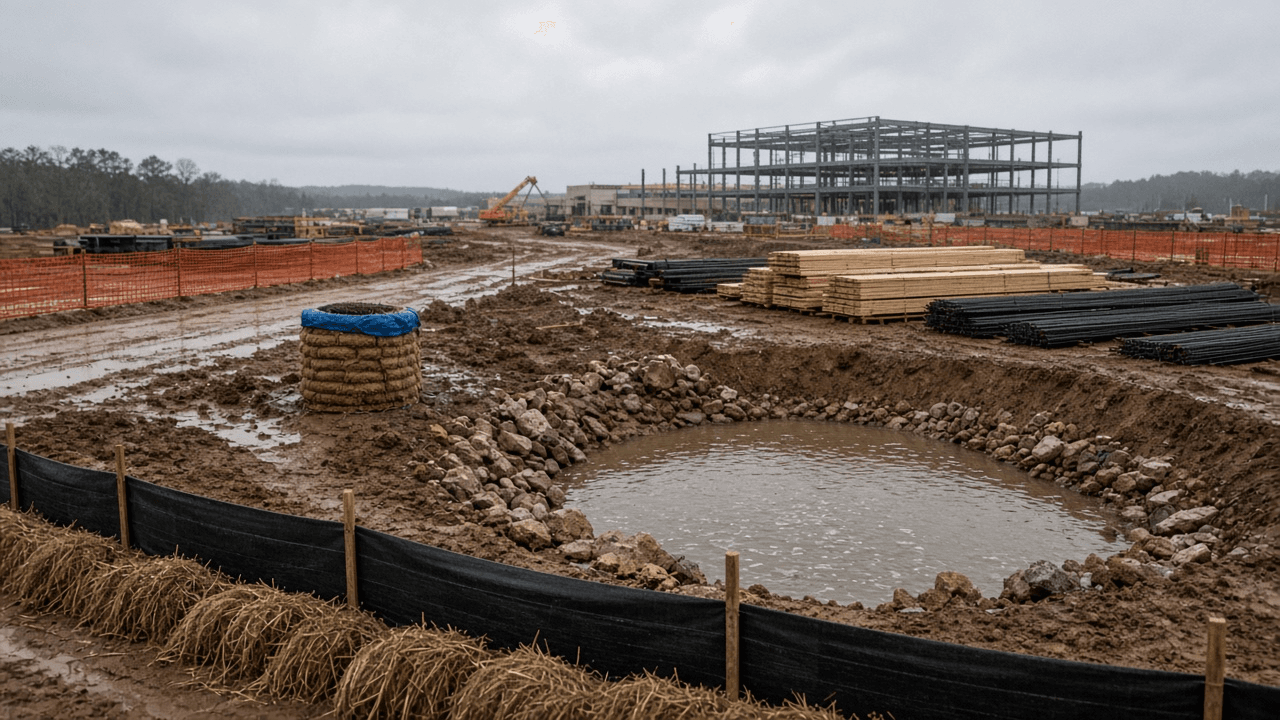
If you install a sediment basin, the proposal would require stabilization of the basin embankment and side slopes (and related conveyance/discharge points) after initial construction and before first use. EPA cites inspection findings where basins were put into service right after excavation and became a sediment source themselves.
4. Streamlining (selected highlights)
- Perimeter controls clarified as needed only where stormwater from disturbed areas can reach them (not “fence the whole site” by default).
- Clearer stabilization deadlines for arid, semi-arid, and drought-stricken areas.
- Temporary flexibility when sudden snow or frozen ground makes immediate stabilization impracticable.
- Fewer photos with the Notice of Termination (drop the “before” set; keep post-stabilization photos).
- Possible turbidity monitoring/reporting relief for some dewatering situations (EPA solicited comment; not locked as final text).
EPA also proposes a five-year term and estimates a small net decrease in incremental paperwork/cost burden versus the 2022 CGP, driven largely by streamlining (including NOT photo relief).
Who cares
Direct coverage: Operators of construction activity disturbing one or more acres (or less than one acre as part of a larger common plan) in areas where EPA is the NPDES permitting authority. The FR notice and proposed Appendix B list includes, among others: Massachusetts, New Hampshire, New Mexico, most Indian country lands, the District of Columbia, Puerto Rico and certain Pacific territories, Lands of Exclusive Federal Jurisdiction, and certain federally operated project areas in selected states. It does not automatically rewrite every state-authorized construction stormwater program.
Practical audience:
- SMB general contractors and specialty trades who pull EPA CGP coverage today.
- Owners/developers and QEPs/consultants who write SWPPPs for those sites.
- EHS leads who own NOI timing, inspection programs, and basin/dewatering controls.
Indirect signal: Many state CGPs track EPA’s model. Even if you are under a state permit (not EPA CGP), watch your state for parallel SWPPP-with-NOI, basin, or narrative WQ edits when your state reopens its CGP.
What to do (now through early 2027)
- Confirm you are (or are not) in EPA-authority geography. Do not assume every job needs the federal CGP. Check proposed Appendix B / your current coverage letter.
- Inventory SWPPP readiness for electronic NOI attachment or URL. Digitize the current SWPPP, decide full-file vs URL vs site-map + certification path, and scrub anything that should stay restricted before you would upload it.
- Walk sediment-basin practice. If basins are on the menu, build “stabilize embankment/side slopes before first use” into design specs and field hold-points. Do not route stormwater to a raw excavation.
- Map dewatering and sensitive-water sites. Keep current turbidity monitoring discipline until any final streamlining lands. Do not drop daily monitoring based on a proposal alone.
- Plan re-NOI timing. EPA intends to finalize before the 2022 CGP expires. Existing 2022 CGP coverage can continue for a limited period after expiration under the proposal’s extended-coverage mechanics while operators update plans and file a new NOI. Build calendar time for SWPPP updates and NOI submission; do not wait until the last week of February 2027.
- If you are on a state CGP, bookmark your state water board’s stormwater page and treat EPA’s package as an early warning, not as your enforceable text.
Bottom line
The proposed 2027 CGP is not a surprise rewrite of every BMP on every site. The sharp edges for most EPA-CGP operators are SWPPP visibility at NOI, basin stabilization before first use, and cleaner water-quality narrative language after San Francisco v. EPA. Comment period is closed. Use the months before the 2022 CGP expires to get SWPPPs, basin specs, and re-NOI workflows ready.
Safety-Chat / Provisio EHS will update when EPA issues the final 2027 CGP. Until then, work from the proposed permit and fact sheet, and verify dates against EPA’s live CGP page.
Sources (primary)
All claims above were checked against these sources on Sep 26, 2026 (America/Denver):
-
Federal Register notice, Aug 3, 2026, 91 FR 48862 (Document No. 2026-15656; Docket EPA-HQ-OW-2025-0760) - proposed 2027 CGP summary, geographic coverage, San Francisco WQ edits, SWPPP-with-NOI options, sediment-basin stabilization, streamlining items, original Sep 2 comment deadline, FR text stating 2022 CGP expires Feb 17, 2027.
https://www.federalregister.gov/documents/2026/08/03/2026-15656/national-pollutant-discharge-elimination-system-npdes-2027-issuance-of-general-permit-for-stormwater
Retrieved: Sep 26, 2026 ~5:17 AM MDT (America/Denver) -
EPA NPDES page: Proposed 2027 Construction General Permit (CGP) and Related Documents - states 2022 CGP expires Feb 16, 2027; confirms comment deadline extended to Sep 17, 2026; links proposed permit, appendices, fact sheet. Last updated Aug 21, 2026 per page metadata.
https://www.epa.gov/npdes/proposed-2027-construction-general-permit-cgp-and-related-documents
Retrieved: Sep 26, 2026 ~5:18 AM MDT (America/Denver) -
Extension claim primary: EPA proposed 2027 CGP page (source 2) states EPA extended the deadline to September 17, 2026, and that the original Sep 2 FR deadline no longer applies. Corroborating EPA page: https://www.epa.gov/npdes/stormwater-discharges-construction-activities (same Sep 17 extension language).
Secondary only (not required for outbound): regulations.gov document ID EPA-HQ-OW-2025-0760-0017 is linked from EPA materials but its body returns CloudFront 403 from this environment, so title/posted date are not quoted here.
Secondary corroboration only (not used for unique claims): SBA Office of Advocacy alert, Aug 17, 2026 - https://advocacy.sba.gov/2026/08/17/epa-extends-comments-period-for-draft-2027-construction-general-permit/ (retrieved Sep 26, 2026 ~5:18 AM MDT).
Next step
If your sites sit under EPA CGP coverage (or you write SWPPPs for those operators), line up SWPPP packaging, basin specs, and re-NOI timing before the 2022 permit expires. Talk to Provisio about construction safety consulting, or see Provisio Core if the gap is inspections and corrective-action tracking across jobs.
Ready to Improve Your Safety Management?
Explore Provisio EHS solutions to streamline compliance and protect your workforce.
Schedule Your OSHA Audit
Let our industrial hygiene professionals identify your compliance gaps before regulators do.
Try Provisio EHS Free
Get 30 days of full access to our safety management platform. No credit card required.
Start Your Free TrialSee How It Works Together
Explore our Audit + Software Implementation Bundle. Get compliant and automate faster.
Get Bundle Pricing