
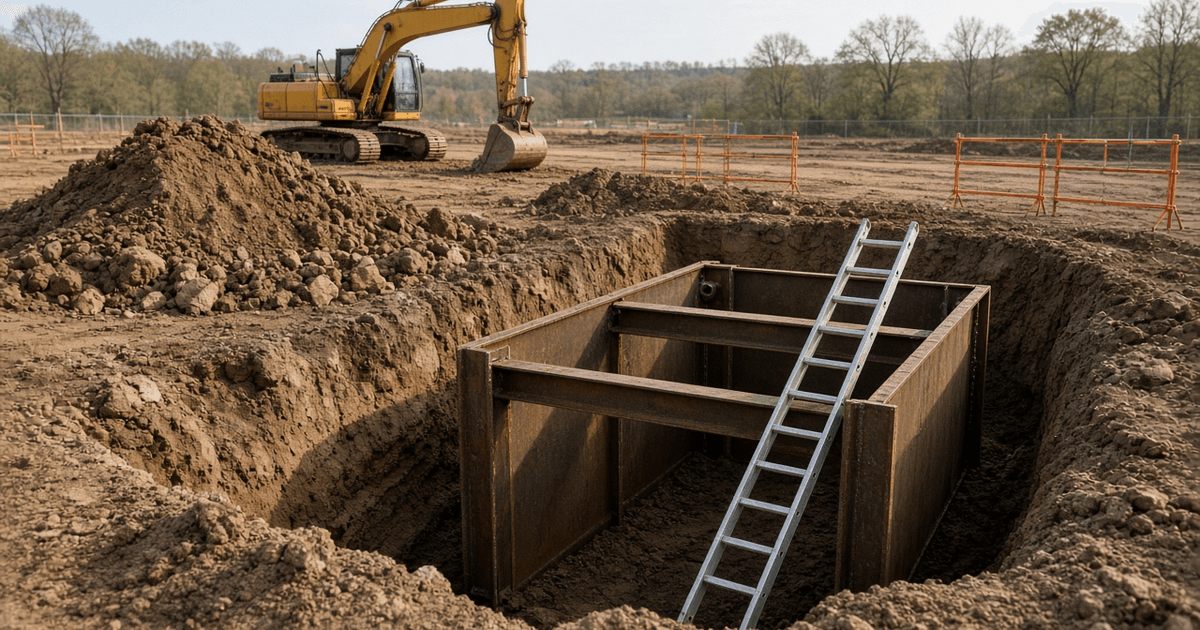
Between October 7 and October 22, 2026, federal OSHA announced three separate excavation cases with more than $1.28 million in combined proposed penalties. One followed the death of a young worker in a trench collapse. Two involved repeat violations, meaning OSHA had cited the same employer for the same or similar problem before.
None of the hazards were new or complicated. They were the basics of trench safety: cave-in protection, a safe way out, spoil piles kept back from the edge, and a competent person watching the excavation. Here is what OSHA cited, and what it means for anyone running crews below grade.
Case 1: A fatal cave-in in Pennsylvania
An excavation contractor's crew was installing a storm sewer about 12 feet below ground. According to OSHA, the trench was not adequately protected, and when part of the wall failed, the soil engulfed a worker, who died.
OSHA issued a willful citation for failing to protect workers from cave-ins. It issued two repeat citations: one for not having a competent person conduct daily trench inspections, and one for not removing employees from hazardous conditions. Serious citations covered construction hazard prevention training, a safe means of exit, keeping materials at least 2 feet from the edge, and restraining materials that could roll into the trench. OSHA proposed $254,884 in penalties.
Case 2: Six employers, one deep excavation in New York
On a large mixed-use commercial project in New York, OSHA responded to an allegation of struck-by and collapse hazards. Investigators found an excavation with a steep, unstable embankment nearly 75 feet high that was not adequately sloped or shored.
OSHA cited the general contractor and five subcontractors, issuing 23 serious and five willful citations with a combined $648,094 in proposed penalties. The citations covered cave-in, struck-by, and chemical hazards, falling or rolling rock and soil, and the lack of daily competent person inspections. Two employers were cited as willful for not making sure the excavation, which was between 21 and 75 feet deep, was designed by a registered professional engineer. Some subcontractors were also cited for fall protection and chemical hazards.
The lesson for multi-employer sites is clear. OSHA cited the general contractor and five subcontractors, not just one company.
Case 3: Repeat violations in Illinois
OSHA inspected an Illinois utility construction company under its National Emphasis Program on Trenching after seeing employees working in an unprotected trench deeper than eight feet. The agency cited three repeat violations: no safe means of egress, no protective system against cave-ins, and failure to keep excavated materials and equipment at least 2 feet from the edge. A serious citation covered missing hard hats. OSHA proposed $380,664 in penalties.
Note how this case started. The release describes no injury. Inspectors saw an unprotected trench and opened an investigation under the emphasis program.
What the rules actually require
The federal excavation standards in 29 CFR 1926 Subpart P are short and specific. The citations above map directly to a handful of requirements:
- Cave-in protection. Each employee in an excavation must be protected by an adequate protective system (sloping, benching, shoring, or a shield) unless the excavation is entirely in stable rock, or is less than 5 feet deep and a competent person finds no indication of a potential cave-in (1926.652(a)(1)).
- Engineer design when required. Sloping and benching must follow one of four options in 1926.652(b): a slope no steeper than 1.5 horizontal to 1 vertical, the Subpart P appendices, other tabulated data approved by a registered professional engineer, or a design approved by a registered professional engineer. Shoring and shields follow parallel options in 1926.652(c), including the manufacturer's tabulated data. Any system that does not use one of the other options must be approved by a registered professional engineer (1926.652(b)(4) and (c)(4)). Under Appendix B to Subpart P, sloping or benching for excavations greater than 20 feet deep must be designed by a registered professional engineer, and the timber shoring tables in Appendix C cover trenches up to 20 feet deep only.
- A safe way out. Trenches 4 feet or deeper need a stairway, ladder, ramp, or other safe means of egress within 25 feet of lateral travel for employees (1926.651(c)(2)).
- Spoils and equipment back from the edge. Materials and equipment must be kept at least 2 feet from the edge, or held back with retaining devices, or both (1926.651(j)(2)).
- Daily competent person inspections. A competent person must inspect the excavation, adjacent areas, and protective systems daily, before work starts and as needed during the shift, and after rainstorms or other events that increase hazards (1926.651(k)(1)).
- Get people out. When the competent person finds signs of a possible cave-in, protective system failure, or a hazardous atmosphere, exposed employees must be removed until it is safe (1926.651(k)(2)).
Why "repeat" should get your attention
Two of the three federal cases included repeat citations. Under OSHA's Field Operations Manual, a violation can be cited as repeated when the employer was previously cited for the same or a substantially similar hazard, that earlier citation became a final order, and the new citation generally comes within five years. The earlier violation does not have to be at the same jobsite. Repeat and willful violations also carry much higher penalties. OSHA's current maximums, for penalties assessed after January 15, 2026, are $16,550 per serious violation and $165,514 per willful or repeated violation. That gap helps explain the size of these totals.
The usual cause is not a lack of knowledge. It is a lack of habit. The trench box stays on the truck for a "quick" tie-in. The morning inspection gets skipped when the schedule is tight. The ladder is 60 feet down the trench instead of next to the crew.
A quick field checklist
- Name a competent person for every excavation, by name, before digging starts. Make sure they have the authority to stop work.
- Decide the protective system before the excavator shows up. Match it to soil type and depth, and get engineer design or tabulated data on site when the job calls for it.
- Put egress in the plan. For trenches 4 feet or deeper, place ladders or ramps so no one travels more than 25 feet to get out, and move them as the work moves.
- Keep the 2-foot zone clear. Set spoil piles, pipe, and equipment back from the edge, or use retaining devices.
- Inspect and document daily, before each shift and after rain or any change in conditions.
- On multi-employer sites, confirm who is responsible for the excavation and make sure every subcontractor's crew is covered.
- Look back at past citations. If your company or a subcontractor has been cited before, check that the corrective action is actually happening on today's jobs.
A California note
Cal/OSHA also announced $212,500 in proposed penalties against two employers on October 15, 2026, after a tunnel collapse in April killed one worker and seriously injured another. Cal/OSHA found that work went ahead without removing or adequately supporting identified dangerous ground. One employer has appealed. California's tunnel safety standards require competent person inspections of underground work areas and ground support, and require dangerous ground to be removed or supported before other work proceeds. Below-grade work in any form gets the same scrutiny.
Need help with excavation safety?
Provisio EHS can review your excavation program, competent person training, and field inspection forms, or walk an active job with your superintendent. Call us at 385-316-2837 to set up a review.
The citations described here are allegations. Each employer has the right to contest them before the Occupational Safety and Health Review Commission (or, in California, the Occupational Safety and Health Appeals Board). This post summarizes federal and California requirements and is not legal advice.
Sources
All retrieved Oct. 27, 2026.
- OSHA news release, fatal trench cave-in, Pennsylvania excavation employer (Oct. 7, 2026)
- OSHA news release, excavation hazards, six construction employers in New York (Oct. 16, 2026)
- OSHA news release, repeat trenching violations, Illinois utility construction company (Oct. 22, 2026)
- OSHA, News releases
- OSHA, Penalties
- OSHA Field Operations Manual, Chapter 4: Violations
- OSHA, 29 CFR 1926.651 Specific excavation requirements
- OSHA, 29 CFR 1926.652 Requirements for protective systems
- Cal/OSHA news release 2026-83, fatal tunnel collapse citations (Oct. 15, 2026)
Ready to Improve Your Safety Management?
Explore Provisio EHS solutions to streamline compliance and protect your workforce.
Schedule Your OSHA Audit
Let our industrial hygiene professionals identify your compliance gaps before regulators do.
Try Provisio EHS Free
Get 30 days of full access to our safety management platform. No credit card required.
Start Your Free TrialSee How It Works Together
Explore our Audit + Software Implementation Bundle. Get compliant and automate faster.
Get Bundle Pricing